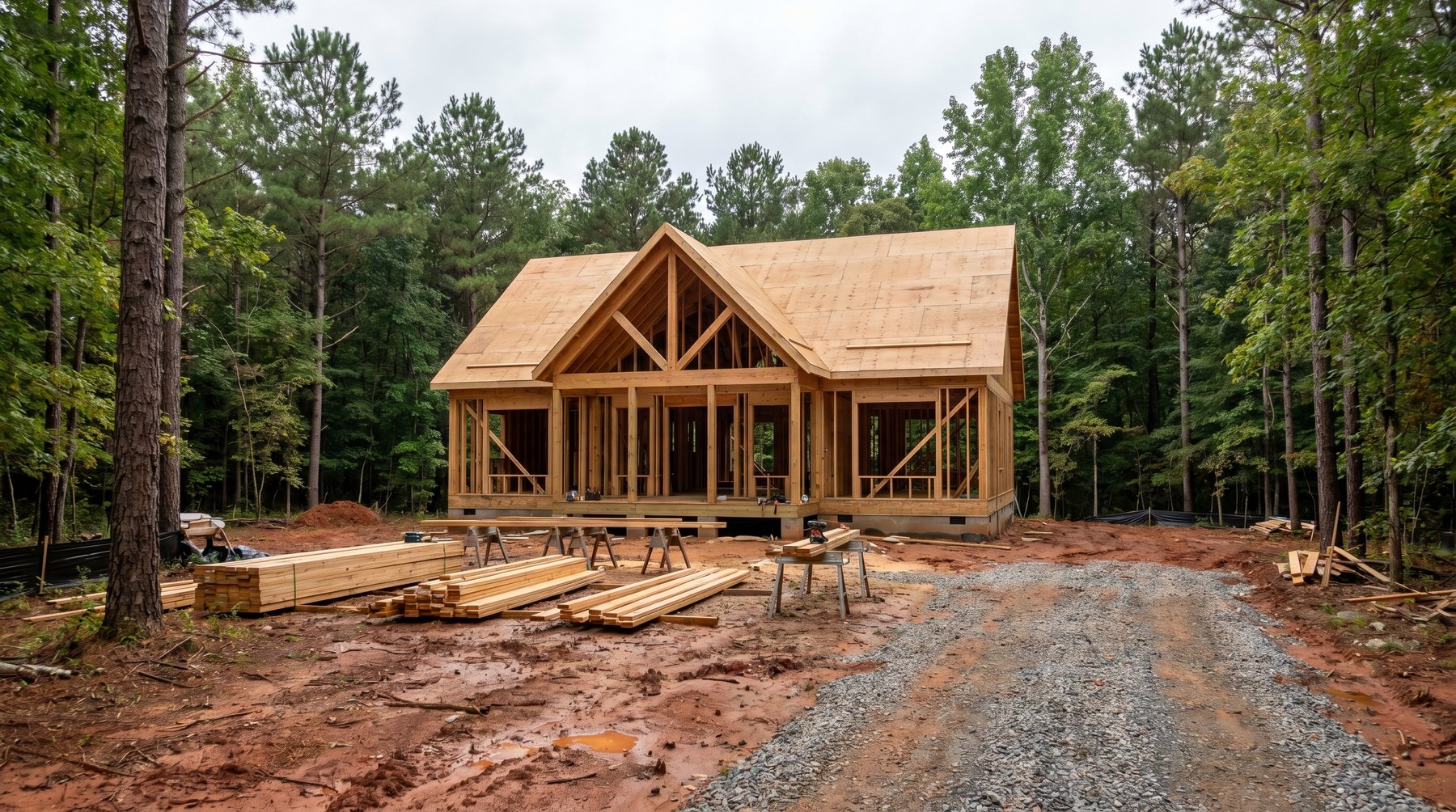
Most new houses in the South are built on a slab or other foundation type, and crawl spaces are a small share. Our homes sit on a crawl space foundation with rebar-reinforced footings. North Carolina's code also allows a closed crawl space, sealed from outside air and kept dry by equipment, and research done in this state found these stay far drier than old-style vented ones.
What do most new homes here sit on?
The U.S. Census Bureau published its 2025 figures on new housing on July 1, 2026. Its numbers are for the South as a whole, the Census region that includes North Carolina, not for the state or the Triangle.
According to the Census foundation table, 584,000 new single-family homes were completed in the South in 2025:
- 88% on a slab or other foundation (the "other" includes raised supports such as pilings and piers)
- 8% on a crawl space, down from 19% in 2010
- 4% with a full or partial basement
The National Association of Home Builders analyzed Census survey data and found that 85.7% of new single-family homes in the South Atlantic division were built on slabs in 2024. NAHB says crawl space foundations "have seen a long-term decline."
Crawl spaces still have real advantages. A 2005 guide from Advanced Energy, a Raleigh nonprofit set up by the N.C. Utilities Commission, notes that they are cheap to build and give a level floor on sloping sites. It also calls them a handy place for plumbing, wiring and heating and cooling ductwork.
What is a closed crawl space?
An older vented crawl space has openings in its walls to let outside air through. The Advanced Energy guide warns that in a humid spring and summer, vented crawl spaces often show wet insulation, mold, condensation on ducts and pipes, and sometimes wood rot.
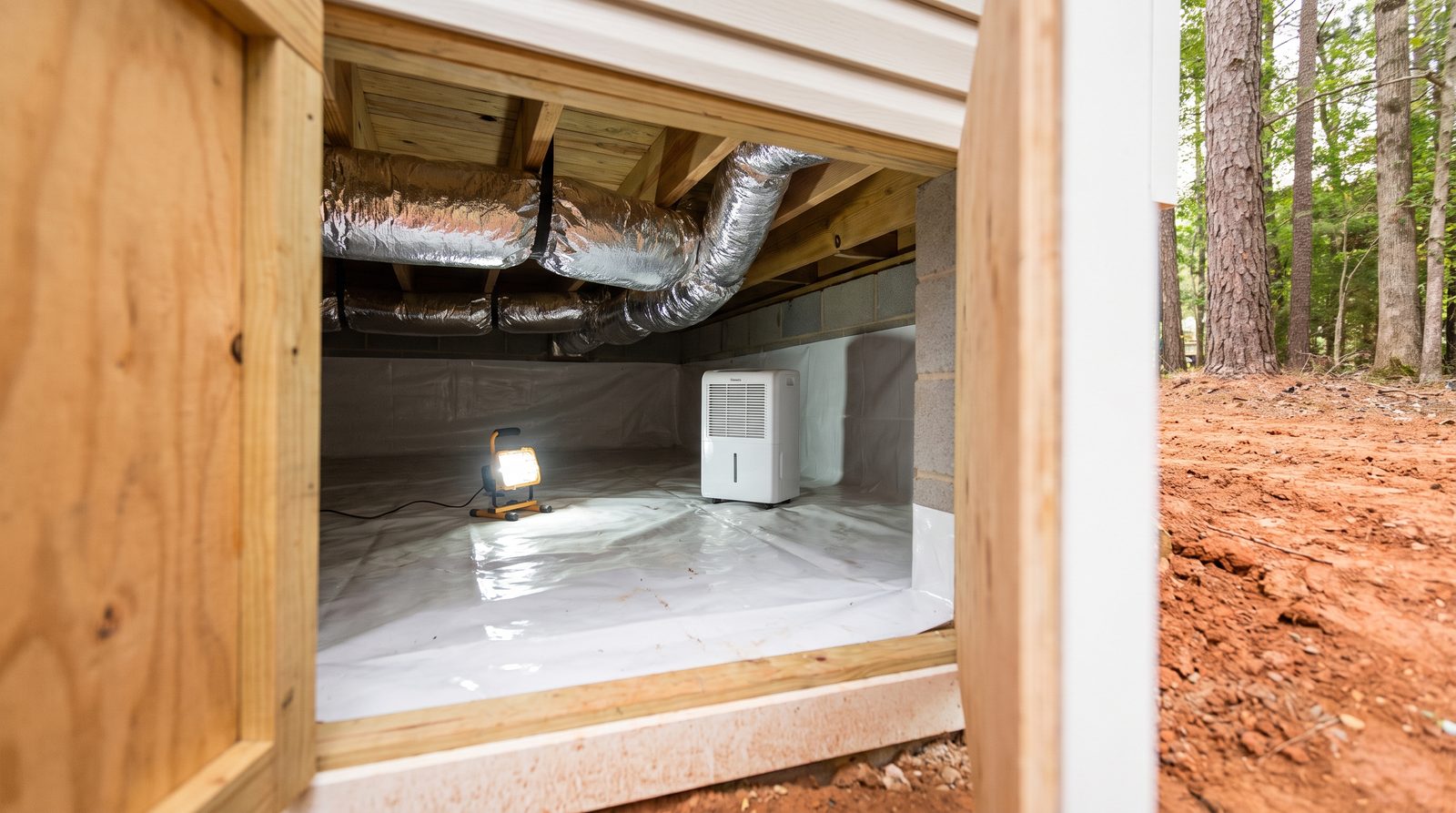
A closed (also called sealed or unvented) crawl space shuts that outside air out. The guide lists five key parts:
- Exterior water management that keeps liquid water out
- Drains or pumps that remove water from plumbing leaks or floods
- Air-sealed walls that keep humid outside air out
- Vapor retarders, sheets that block moisture rising from the ground
- Mechanical drying
Even a well-built closed crawl space picks up some moisture, the guide says, from the ground through masonry, from rain, from air pushed in by leaky ducts, or from plumbing failures. That's why it needs active drying.
The research behind this came from twelve homes in Princeville, in eastern North Carolina, funded jointly with the U.S. Department of Energy. In the vented crawl spaces, relative humidity stayed above 80% for most of the spring and summer. The closed designs kept it below 65%, and a federal summary of the project puts the heating and cooling energy savings at "on average, 15% or more." The work led to a 2004 revision of the state's residential crawl space rules.
On a lot in a FEMA Special Flood Hazard Area, the Advanced Energy guide says the crawl space wall must have flood vents that meet FEMA rules, even when the crawl space is closed. Checking the flood maps is part of checking a lot, and that's our job as the builder.
What does North Carolina's code ask of a closed crawl space?
The NC Office of State Fire Marshal (OSFM) says on its codes page that the 2018 NC codes, effective Jan. 1, 2019, "are currently effective." A newer 2024 code was delayed by a 2025 state law, and until it takes effect the 2018 code stays in effect. Which edition applies is part of the permit work, and we handle the permits.
Under the 2018 code, moisture in a closed crawl space must be controlled. According to an OSFM interpretation dated Dec. 11, 2025, Section R409.5 lists five ways to do it in a closed crawl space:
- A permanent dehumidifier with a condensate pump or drain and an electrical outlet
- Supply air ducted from the home's air conditioning
- A fan blowing house air into the crawl space
- An exhaust fan
- Designing the crawl space as heated and cooled space
What does the foundation mean for ducts and termites?
Ducts. The Department of Energy's Building America Solution Center says a sealed, insulated crawl space gives ducts and equipment a protected home and keeps humid air from condensing on floor joists. It recommends a 6-mil plastic vapor retarder on the floor and walls and sealed vents, and for ducts there, short, compact runs that are sealed and tested for leaks.
Termites. NC State Extension says poor ventilation can cause condensation in crawl spaces, which raises termite risk. It describes a properly sealed crawl space as one where moisture "is greatly reduced but inspection gaps have been left." Treatment differs by foundation:
- Crawl space: soil is trenched and treated along the outside and inside of the foundation wall and around piers.
- Slab: the outside is treated the same way. Inside, a bare slab is drilled, or treatment is often "waived" where finished floors would be damaged.
Sources
- CHARS – Current Data · U.S. Census Bureau · July 1, 2026
- Type of Foundation in New Single-Family Houses Completed (XLS) · U.S. Census Bureau · July 1, 2026
- Which Foundation Type Is Most Common in Your Region? · NAHB
- Closed Crawl Spaces: An Introduction to Design, Construction and Performance · Advanced Energy (with U.S. DOE)
- Closed Crawl Space Performance: Proof of Concept in the Production Builder Marketplace · N.C. Advanced Energy Corp. / DOE OSTI
- Codes – Current and Past · NC Office of State Fire Marshal
- North Carolina Delays Implementation of 2024 State Building Code · NC OSFM · April 7, 2025
- 106.1 – Permit Required for Closed Crawl Space · NC OSFM · December 11, 2025
- Unvented, Insulated Crawlspaces · U.S. DOE Building America Solution Center (PNNL)
- Monitoring and Management of Eastern Subterranean Termites · NC State Extension · January 22, 2025