In Durham County, how a new home gets its water and handles its wastewater depends on where the lot sits. Inside City of Durham limits, a lot can get city water and sewer. Outside them, a house typically needs a septic system, and often a well, permitted by the county, unless the City Council approves the owner's petition to annex the land, or the lot is served by county sewer or the county's Rougemont water system (which supplies water, not sewer).
Checking which of these applies is our job as the builder, and we do it before you commit to a lot. Here is how each path works, so you know what we're looking at and why it matters.
Who permits septic and wells in Durham County?
Outside the city's water and sewer lines, the key office is the county's Onsite Water Protection section, part of the Environmental Health Division of the Durham County Department of Public Health. It oversees septic systems and private wells. Its staff do the site evaluations for septic and well permits, inspect septic systems and wells while they are built, and test well water.
A septic permit comes in two steps:
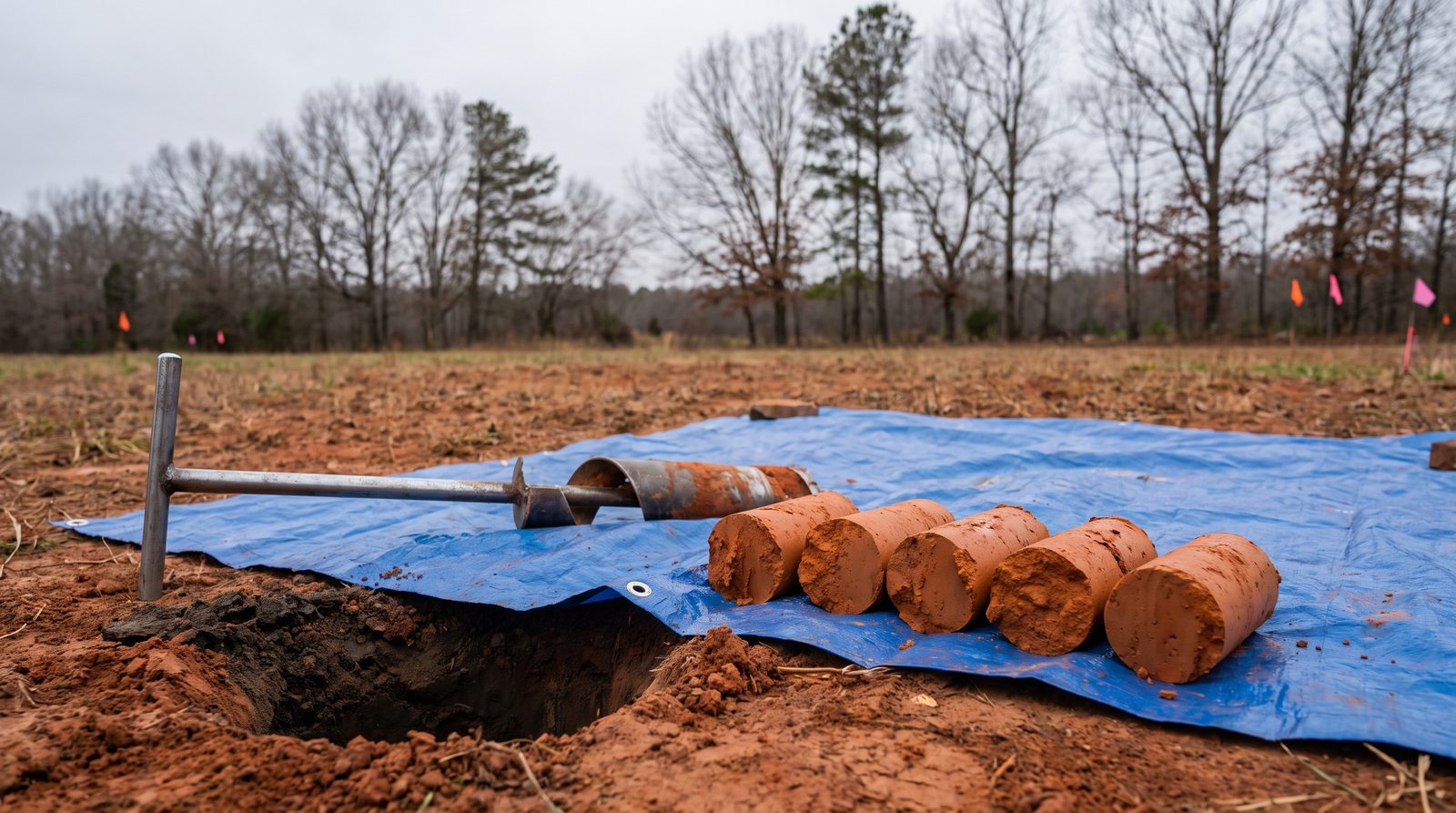
- The Improvement Permit. The county evaluates the site to see whether the soil can handle a septic system, and where.
- The Construction Authorization. This approves the specific system to be installed.
The county's forms page carries the new-home application, called "Improvement Permit / Construction Authorization - New Construction," along with a separate Well Permit Application and a Water Sample Application.
How we help: We handle these applications and the permits that follow. Whether the soil percs for a septic system is one of the two questions that usually decide whether a lot works, so it's one of the first things we look at when we walk a lot with you.
What do the county's septic and well permits cost?
The Environmental Health fee schedule, which carries no date, lists:
- Improvement Permit application (the site evaluation, limited to 2 acres): $250
- Construction Authorization, Type I or II system: $200
- Construction Authorization, Type III (pump) system: $350
- Construction Authorization, Type IV, V or VI system: $525
- Improvement Permit revisit: $100
- Well Permit: $425
- Bacteriological water sample (total coliform/E. coli): $135
- Inorganic water sample (includes nitrate/nitrite): $135
- Multiple trip fee: $50
For tracts larger than 2 acres that a licensed soil scientist has already evaluated, with a sealed report submitted, the county charges $200 and evaluates only the area the consultant specifies. The county says all Environmental Health fees are non-refundable.
Can a lot outside city limits get city water and sewer?
Sometimes, through what the City of Durham calls voluntary annexation: an owner asks the city to bring the property into the city so it can get city services. The city says connecting to city water or sewer is the most common reason.
There are two kinds of petition. A contiguous petition is for land that touches the city's main limits; a non-contiguous, or "satellite," petition is for land that doesn't. The city lists these steps:
- A presubmittal meeting with the Growth Management Team, which counts for six months.
- A formal petition.
- A virtual neighborhood meeting.
- Staff review: a fiscal impact analysis, the City Clerk's review of whether the petition is sufficient, and a Utility Extension Agreement drafted by Public Works to extend utilities to the site.
- A Planning Commission public hearing, with mailed notice to owners within 1,000 feet, signs on the property and a newspaper notice.
- A City Council public hearing, where the council makes the final decision.
An approved annexation takes effect on a quarterly date after the council approves it, such as March 31, June 30, September 30 or December 31. The city also charges capital facility fees on water and sewer, which help pay for improvements needed for growth.
How we help: When we walk a lot with you, we check whether it sits inside city limits and talk through what city service would involve.
What about county sewer and Rougemont water?
Durham County runs its own sewer utility, and in some areas, the Rougemont water system. Its Utilities Division FY27 Fee Schedule, effective July 1, 2026, lists a system development fee of $1,250 per bedroom for a home.
The monthly county sewer charge for customers without city water is $86.45 for one or two bedrooms, $129.68 for three, and $172.91 for four or more. Customers who also have city water pay $8.86 per hundred cubic feet plus a monthly service charge by meter size ($4.67 for a 5/8-inch meter). Rougemont water carries a $5.00 monthly administrative fee, an $18.00 monthly base charge for a meter under 1 inch, and $7.53 per 1,000 gallons for use under 10,000 gallons.
Because several of these charges are set by bedroom count, it helps to settle how many bedrooms you want early.
How does this fit into our price?
Every one of our plans has its price published, and the published prices include the building permits. Site work is typically in the published price too: the survey and plot plan, soil testing and the septic design, a well drilled up to 300 feet, a conventional septic system, and connection to public water and sewer where available. A site visit confirms it for your lot.
You get one all-in price before you sign. Once you sign, it changes only for the upgrades you choose and a well that has to go past 300 feet. If a lot would need an engineered septic system, we'll usually tell you to pass on that lot rather than price around it.
Your next step: Send us the address of a Durham County lot you're considering, and we'll walk it with you and tell you straight whether it's a fit for the home you have in mind.
Sources
- On Site Water Protection · Durham County Department of Public Health
- General Inspection Forms & Applications · Durham County Department of Public Health
- Fee Schedule (Environmental Health Division) · Durham County Department of Public Health
- Annexations · City of Durham Planning & Development
- Capital Facility Fees · City of Durham