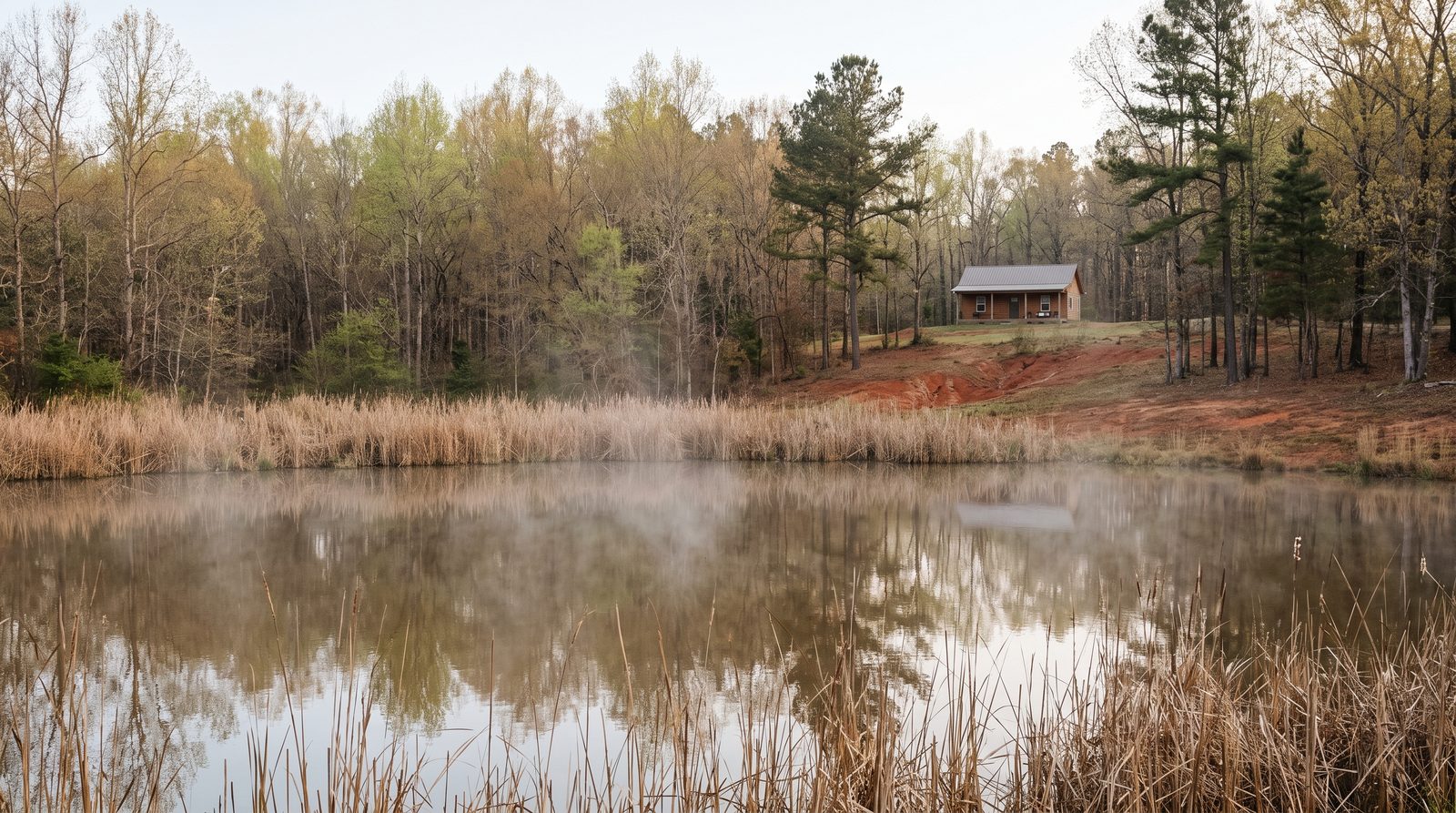
Often you can, but not right next to the water. In the Neuse River basin and the Jordan Lake watershed, state rules protect a strip 50 feet wide on each side of a covered stream, pond or lake, and the house, the septic system and most driveway work have to fit around it. Almost every lot has something; the walk-through is where we talk through what's straightforward, what's expensive, and what's a deal-breaker before you commit a dollar.
Which streams and ponds are covered?
NC DEQ's Division of Water Resources (DWR) runs buffer rules that protect the plants along streams, lakes, ponds and reservoirs. DEQ says the Neuse rules exist to remove nutrients headed downstream, and the Jordan Lake rules exist to protect water supplies.
The Neuse rule covers all landowners in the basin, including the Falls Lake watershed. A stream or pond is covered if it appears, even roughly, on the latest NRCS soil survey map or the USGS National Map. In Johnston County, the county says streams in the county are subject to the Neuse buffer rules.
A map isn't the last word. DEQ's guide says a stream that shows on either map is covered by default, and a stream evaluation can settle it. Under the Neuse rule, certified staff visit the site and can find that a mapped feature is not covered if it is a ditch or man-made channel, a man-made pond not connected to a stream, an ephemeral stream (one that runs only briefly after rain), or simply not there. That decision lasts five years. Who makes the call depends on where the lot is: in unincorporated Wake County, the county says DEQ's Raleigh Regional Office does the checks in the Neuse basin and Wake County Watershed Management does them in the Cape Fear basin. Some towns run the rules themselves.
How close can the house, septic and driveway be?
Under the Neuse rule, the buffer has two parts. Zone 1, the 30 feet closest to the water, must stay undisturbed apart from uses the rule allows. For streams it is measured from the top of the bank or the edge of the rooted plants along it, whichever is farther from the water; for ponds and lakes, from the normal water level. Zone 2, the next 20 feet, must stay covered in plants; it can be graded and replanted as long as Zone 1 is not harmed. The Jordan rule uses the same 30-plus-20 layout, and local governments there may require wider buffers.
What the Neuse rule says about the pieces of a homesite:
- The house: if the rule would prevent building a single-family home, the home may reach into the buffer only if it sits as far from the water as the lot allows, is designed to intrude as little as possible, meets the rule's stormwater requirements, and keeps every part of any septic tank and drainfield out of the buffer. Reaching into Zone 2 needs authorization; reaching into Zone 1 also needs mitigation (making up for the impact).
- Septic: new ground-absorption septic systems are prohibited in the buffer.
- Driveways: a straight crossing with 1/10 acre of buffer impact or less is deemed allowable; more than that, up to 1/3 acre, needs authorization; beyond 1/3 acre, or a driveway running along the stream, needs mitigation.
- Small things: playground equipment that removes no plants, and fences that keep Zone 1 trees, are deemed allowable.
DEQ's buffer FAQ explains the labels: deemed allowable uses need no DWR approval, others need written authorization, and prohibited uses need a variance. DEQ says impacts can be approved only when there are "no practical alternatives."
Uses already in the buffer on July 22, 1997 and continued since, such as buildings, existing septic systems, or lawns you can mow without a chainsaw or bush-hog, are not affected by the Neuse rule, and buying or inheriting the land does not change that. In the Jordan watershed, the date is the day the local government's buffer program took effect, or August 11, 2009, for work the state oversees directly.
What about wetlands and federal permits?
DEQ says DWR decides where streams exist, and the U.S. Army Corps of Engineers decides which wetlands fall under Section 404 of the Clean Water Act. A stream does not have to be on a map to be regulated. Wetlands next to or within 50 feet of covered water count as part of the buffer, though they are regulated under a separate state rule.
A Corps 404 permit is needed to put fill into streams, wetlands or open waters, and a state 401 certification usually comes with it. Disturbing a stream's banks or a wetland, damming a stream for a pond, or filling for a culvert may all need permits. The Corps calls mapping wetlands a jurisdictional determination, or delineation; it is generally good for five years.
Your next step: tell us how you hope to use the water, whether that's a view from the porch, a path down to the bank, or a pond you'd like to dig. Any of those can change where the house goes, or what permits it needs. For questions about a purchase contract on land with water, a real estate attorney can help.
Sources
- Riparian Buffer Protection Program · NC DEQ Division of Water Resources
- 15A NCAC 02B .0714 Neuse River Basin buffer rule · NC Office of Administrative Hearings · June 15, 2020
- Riparian Buffer Information · Johnston County Public Utilities · July 30, 2026
- Guide: Determine if Your Stream is Subject to Riparian Buffer Rules · NC DEQ
- 15A NCAC 02B .0267 Jordan water supply buffer rule · NC Office of Administrative Hearings · July 7, 2014
- 401 & Buffer Permitting Frequently Asked Questions · NC DEQ
- Riparian Buffers · Wake County
- Jurisdiction: Wetlands, Streams and Waters Regulated by the Corps · U.S. Army Corps of Engineers, Wilmington District