Short version Drain field size is driven by two things — how many bedrooms your house has and what the soil will accept. North Carolina sizes residential septic at 120 gallons per day per bedroom (a 4-bedroom home = 480 GPD), and the soil's Long-Term Acceptance Rate determines how many square feet of field you need to handle that flow. NC also requires a designated repair area held in reserve in case the primary field ever fails — that easily doubles the ground you have to set aside. On tight lots, system designs like T&J panels can cut the required footprint by about 50%. On lots with marginal soil — common in parts of Durham and Chatham counties — engineered systems with pretreatment and pressure distribution can make the lot work, but they cost meaningfully more. Nothing permanent can sit on top of a drain field or repair area. Here's the practical picture.
How big does the drain field actually need to be?
Two inputs drive it. Bedroom count sets your design flow. Under North Carolina's updated onsite wastewater rules — 15A NCAC 18E, effective January 1, 2024 — residential systems are sized at 120 gallons per day per bedroom, so a 3-bedroom home is sized at 360 GPD and a 5-bedroom at 600 GPD. Soil performance sets how many square feet are needed to handle that flow — that's the Long-Term Acceptance Rate (LTAR), measured in gallons per square foot per day. Better soil means a smaller field; tighter soil means a bigger one. A typical 4-bedroom home on average soil ends up needing several thousand square feet of usable area before you factor in setbacks, the well, and the house footprint.
Why is there a "repair area" — and how much extra space does it take?
North Carolina requires every septic permit to include a designated repair area — ground held in reserve where a replacement drain field could be installed if the primary ever fails. The repair area generally needs to be roughly the same size as the primary, evaluated by the soil scientist for the same suitability. So when you're sizing a lot, you're really planning for two drain fields' worth of space, even though you only ever install one. That's a big part of why we tell clients an acre or more is often the practical floor for a true custom lot.
One exception worth knowing: certain older "lots of record" can be classified as repair exempt, often because the lot pre-dates current rules. That sounds like a gift, but it cuts both ways — if the system ever fails, the owner has no pre-approved place to put a replacement, which is a real risk on marginal soil.
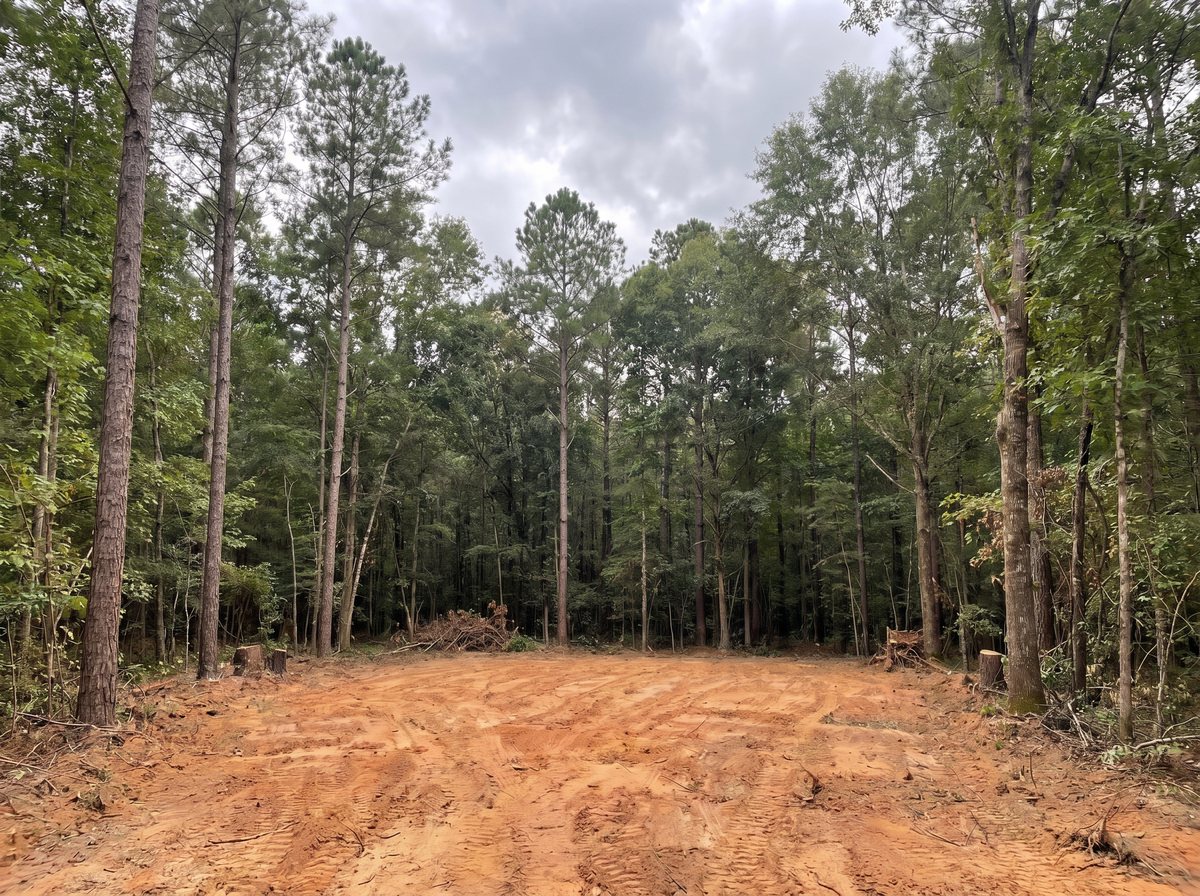
What if the lot is tight on space?
This is where the 50% reduction systems come in. The most common one we see in NC is a T&J Panel System — a Prefabricated Permeable Block Panel System, classified as Type III(b)(g) under NC code. Instead of gravel-filled trenches, the installer sets porous concrete panels into the field, and effluent seeps through the panel walls. The big benefit: it cuts the required field length by roughly half.
It's still gravity-distributed (no pumps, no electricity), but the per-foot cost is higher than a conventional gravel trench because you're paying for a manufactured product and a certified installer. Total installed cost often comes out comparable to conventional once you account for the shorter run. We see T&J panels used both for primary fields on tight Wake County lots and frequently for repair areas where there isn't room for a full conventional reserve.
T&J Panel Systems cut the required drain field footprint by roughly 50%. We use them both for primary fields and for repair areas where there isn't room for a full conventional reserve.
Can low-flow fixtures help shrink the field?
Yes, in some cases. North Carolina allows a reduced drain field design when the home is fitted with documented water-conserving fixtures — toilets at 1.6 gallons per flush or less (EPA WaterSense models go down to 1.28), spring-loaded faucets at 1 GPM or less, and low-flow showerheads at 2 GPM or less. The reduction applies only to the field itself, not to the septic tank size, and the amount of credit is determined by the local health department and the state based on what's specified. It usually requires engineered documentation prepared by a licensed NC professional engineer, so it's not automatic. But on a tight lot where the difference between buildable and not is a few hundred square feet of drain field, low-flow design is a real lever — and one we'll suggest exploring when the math is close.
What about lots with marginal soil?
Some Triangle areas — parts of Durham County, lots near Jordan Lake, sections of Chatham County — have soil that won't support a conventional drain field at all. The limiting condition is usually wetness at shallow depth, expansive clay, or both. When that's the situation, the soil scientist will design an engineered system: imported fill to create artificial usable depth, advanced distribution like a pressure manifold or drip irrigation, and sometimes aerobic pretreatment before the effluent ever reaches the field. These systems work — we've built on lots that needed all three layered together — but they're meaningfully more expensive than a conventional gravity install. They also add ongoing costs (electricity for the pump, more mechanical components to maintain), which is worth factoring into the long-term picture, not just the install bill.
What can't sit on top of a drain field?
Nothing permanent. That means no detached garages, no pools, no outbuildings, no patios that require footings, no driveways. Even the ground itself has to stay relatively undisturbed — heavy equipment driving over the future drain field area, or a landscaper regrading the ground, can compact the soil and damage the system before it's even built. Septic plans typically mark the drain field and repair area explicitly, and the rule "no grading septic area" appears on most NC site plans for a reason. When we lay out a custom home on a lot, we're working around the field and the repair reserve as fixed constraints, not flexible ones.
If you're thinking about a custom home in Raleigh, Apex, Wake Forest, or anywhere else in the Triangle and want help understanding what your specific lot will actually support, reach out — we're happy to walk it with you. You can browse lots for sale across the Triangle on our land search. For more on what to look for in a buildable lot before you put one under contract, see our companion post on what to actually look for in a buildable lot.
What Should You Actually Look For in a Buildable Lot?
More guides: Land
What a Triangle lot's covenants and HOA rules mean before you buy
Where a lot's covenants are recorded, what a North Carolina HOA can do about dues, fines and liens, and what a seller of an empty lot does and doesn't have to disclose.
What Should You Actually Look For in a Buildable Lot?
Two questions usually decide whether a Triangle lot will actually work — does it perc, and what's the topography. Here's the practical version of how we look at a lot when a client brings us one.
The Triangle Building Report
Once a month: what changed for building in the Triangle, and our newest guides. No spam, unsubscribe anytime.